First published in Time Out Sydney, 15 May 2009
(So, back in 2009 I interviewed Brian Eno for the Luminous Festival – which was an early run for what became Sydney’s Vivid Festival. Eno was the first curator of the festival, choosing all of the acts and arranging collaborations. And yes, interviewing him was 100 per cent a dream come true.)
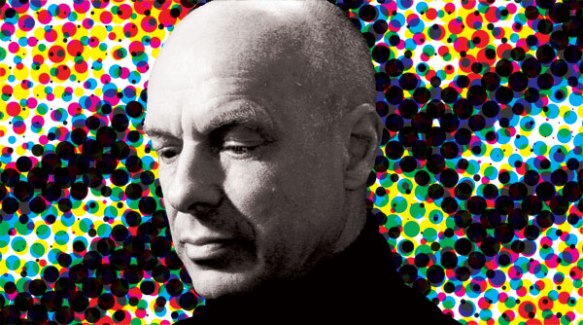
The man’s basically a genius, let’s not muck around.
What governed your choices of performer for Luminous?
Two things: who I wanted, and who I could get.
So there wasn’t an overarching aesthetic?
Yes, there is. The overarching aesthetic is “things I like or want to see”. Things that I think are at the cutting edge of some-or-other form of music that I’m interested in. They’re all things that, to me, seem like pioneers.
So you would argue that Ladytron, who many critics would consider to be pushing a retro-80s-synth sort of thing, are pioneers?
Well, it’s interesting. I think that in music there is no history any longer: everything is present. This is one of the results of digitisation, where everybody owns everything: you don’t just have your little record collection of things you saved up for and guard so carefully. My daughters have 50,000 albums or something each, but not only that they have albums from every era of popular music history, from doo-wop onwards, and they don’t really know what’s current and what was done a long time ago. For instance, they were listening to something a few nights ago – some prog-rock thing, I can’t remember what it was now – and I said “gosh, I remember when that came out we all thought it was really boring,” and she said “what? Is this old then?” [laughs] To her, and many of her generation, everything is equally present so “retro” doesn’t really have quite the same meaning.
But surely something crucial has something been lost in that?
I think something has been lost, and something else has been gained. What’s been lost is evident particularly to my generation because records were so crucially important to us: they so much defined a cultural position and one knew somebody by their choices in records, so it was really the centre of a cultural conversation. And part of the reason for that was that you had to make quite a big investment in your record collection: they were expensive and so you didn’t have that many of them. And I think when you make that kind of investment in something you take it seriously and become committed to it – and you get the benefits of taking it seriously and being committed to it. What then happened was that music became like water – in fact, slightly cheaper than water – and so now there’s a completely different attitude to it. And the healthy part of this new attitude is what I was explaining before: having this undifferentiated field that’s pretty much free of prejudices. The music doesn’t carry so much ideological baggage with it as it used to. I remember when it was politically uncool to like ABBA, for example, and absolutely essential to claim that you admired the Velvet Underground. I think a lot of that is gone, and I think it’s good that it’s gone too.
Is that the only plus?
No, the other thing that I think has happened is that when the music becomes effectively free, everything else that is non-copyable becomes valuable. For instance, performances: there’s so much more live performance in England now than there has been for years, probably ever, and bands take their live performances very seriously. They make records to promote performances, basically, whereas we used to do performances to promote records. Suddenly performance is again very, very lively and interesting, at every level. With the big bands now it’s like the circus coming to town when they turn up, and they really go to town on the technological aspects of what they’re doing. And festivals: there are far more of them than there have been. They’ve become alibis for new sorts of temporary communities among young people, which I like. I think that’s all wonderful.
That’s certainly true in Australia too.
The other thing that’s happened is that because it’s very difficult to sell CDs now, instead what you do now is make fantastic packages. This is becoming a quite new art form, I think. I bought a boxed set the other day – it’s six CDs of early American religious music, old 78s [78 rpm LPs] that have been put onto CD – and it’s in a beautiful wooden box and there’s a a fantastic book with it. It’s a real piece of musical archaeology, beautifully produced, wonderfully done. It’s a combination of beautiful listening experience and academic text and art object – and that really only came about because you can’t make money selling CDs any longer.
However, if the sense of a record as being “a record” of a particular time is lost, doesn’t this feed into a general short-termism in people’s thinking with regards art, politics, social movements…?
You know, I don’t think that’s so. I think the same thing is happening in politics, and possibly across the board, that people have become disaffected with the idea of single, unifying ideologies. So everybody is mixing and matching, picking bits of this and bits of that, and it’s very difficult to find any interesting political thought on the committed left or the committed right. They’re simplistic. They actually seem historical and out-of-touch. To me all the interesting thought is coming from people you can’t place on that spectrum somehow. Their ideas exist all over that spectrum – and I think the same thing is true with music. There are so many bands now that one finds interesting because of the combination of all of the possible historical threads they could have chosen, the ones they have chosen to weave together, you think “ooh, that’s interesting, how could somebody put those things together and get away with it, and make something I like?” So I think that’s kind of what’s happening now with painting, and politics, and economics.
Certainly it’s been an interesting time for economic dogma…
Oh yes – the whole meltdown of the world financial system has really disabused a lot of people of what seemed to be a dominant and here-to-last-for-a-long-long-time ideology, the free market. And remember, it was only 19 years ago that Francis Fukiyama published his book The End of Historywhich claimed, with absolute confidence, that we’d found the solution and it was market capitalism and economic liberalism. And it was only nine years ago that the Americans published their national security document which spoke of this century as being an American Century and that the American approach was the only one left standing after the 20th century. So in a very few years theres’s been an incredible change in atmosphere, and I think it’s been across the board. I don’t think it’s gonna last forever – I’m sure it will harden again into ideologies and simplistic theories, but for the moment, it’s exciting.
Well, the Iraq invasion put the lie to the idea that the free market necessarily brings democracy, and the rise of China disproved the notion that democracy is necessary for a robust economy.
Yes, exactly. What’s happened in the last few years is that there have been some very expensive experiments, Iraq being one of them, and China being another, and Russia being another: that’s another example of authoritarian capitalism. This was thought to be a contradiction in terms – it would have been described as an oxymoron to say “authoritarian capitalism” because the idea, in the Fukiyama picture of things, was that neo-liberal capitalism automatically produced all the social benefits that they were so proud of. And then along comes China and Russia, two countries that clearly are very different, both from us and from each other, and they’ve found two other solutions to the equation. It doesn’t turn out to have one solution.
Your own music is often very experimental, yet you’ve worked closely with huge mainstream bands like U2 and Coldplay: would it be an unfair oversimplification to say they’re simply buying themselves some Eno cred?
Well, no.
That’s impressively candid.
Well, it’s not completely wrongheaded. I’m sure like everybody they want to work with people they like and whose work they admire, and they like mine, they like the things I’ve been involved with, so yes: I’m sure part of it is them saying “I’d like a bit of that as well.” And why not? That’s what I would do if I were them [laughs]. So I don’t think it’s an unfair assessment, but I don’t think it’s a bad thing for them to do. They wouldn’t be upset by somebody saying that to them. If you said “so, are you just trying to buy a bit of Brian Eno’s credibility?” they’d say “well, yeah, maybe.” But actually the real reason they’re doing it is because, like everyone else who’s smart, once you’re successful it’s very easy to get stuck.
Stuck?
Yes, because absolutely everybody in the universe is encouraging you to do more of the same thing. And I don’t, basically. I don’t do it on principle. I’m just not interested in doing more of the same thing. I’m always interested when I hear something that’s like a little shoot, a little bud that I haven’t heard before, and I go “oooh, that’s exciting, let’s see where that goes.” It’s hard for people to realise how rarely that happens for big bands, when somebody is really pushing the new things that they’re doing rather than the old things.
So your job in the studio is to limit what a band’s doing?
Oh, definitely, yes. Because the possibilities increase exponentially: every year there are a thousand new ways to waste time in the studio – every week, actually. And in fact what so often happens when one has trillions of options is that you think you’ll find the answer somewhere among the options if you just keep looking for long enough – and it’s never true, in my experience. The answer, whatever the answer is, is in you. I always notice when I’m drawing with a pencil, which is a very limited tool, I very quickly get to the point of knowing whether I’ve got an idea or not, whether anything good will happen or not, because the tool doesn’t offer than many options for experimentation. You very quickly do all the things you could do with it. And similarly with more simple instruments like electric guitars and drums and so on. Once you get into ProTools, that deadly infection, then anything is possible. There’s the famous joke about the producer who holds down the talkback button in the studio and says to the band “That was absolute shit. Come in.” Because it so often happens – in ProTools you can sort-of fix anything up to make it sound half decent, and I don’t like that. I don’t like to work that way.
But your own life is an example of wild, distracting options: you make music, you write, you paint, you work with corporations, you’re involved with [futurist thinktank] The Long Now… you hardly seem to be limiting your own options.
Well, I do have periods where I am completely lost. And I find I have one useful talent, which is that I can completely forget everything else when I’m working on one thing. I have fairly powerful focus when I need to have it, and I also have enthusiasm for what I’m doing. I have strong opinions, basically, and I think that’s another reason why people like me in the studio, because I get either totally indignant or very excited about things. I rarely feel lukewarm about anything because it really is of no use to anyone to say [affects bored tone] “oh, that’s quite good.” That doesn’t help at all. You want strong positions, and I take strong positions without any effort. And I of course have the same problem that every other musician working with electronics does, which is that there’s constantly new stuff to find out about – but I just decidenot to find out about a lot of it. I sort of have an idea of which area of things would interest me and go somewhere new, and I don’t even bother to look at the rest of it, I don’t want to know. Life is too short.
What sort of things have you ignored recently?
Well, a synthesiser company recently offered me – very kindly – this fabulous new synthesiser, and I had it for two or three days at the studio and I thought “to actually understand this would take about six months, otherwise I’m just going to use the presets they put in there, and I’m much too arrogant to do that.” So I sent it back. I thought, “It’s a waste on me. Give it to some youngster who can really learn it.”
And yet you’re involved in the development of [iPhone self-generating music program] Bloom: clearly you don’t ignore new technological developments…
No, but that’s because for a long, long time I’ve had this thread that I’ve been carrying through, which is this idea of generative music, and whenever I see a new chance of doing that I’m very interested. So the iPhone offered that possibility, because I had realised three or four years ago that I wasn’t going to be able to do generative music properly– in the sense of giving people generative music systems that they could use themselves – without involving computers. And it kind of stymied me: I hate things on computers and I hate the idea that people have to sit there with a mouse to get a piece of music to work. So then when the iPhone came out I thought “oh good: it’s a computer that people carry in their pockets and use their fingers on”, so suddenly that was interesting again.
Isn’t there some irony in your hating music for computers, given that you created the Windows start up chime? I mean, it was designed for a computer and was reportedly the world’s most-heard piece of music.
Well, it was for a while [laughs]. I made one a long time ago, for the 95 Windows, so I had what, a billion or two listeners…
The Sydney Opera House presented Luminous, which ran 26 May–14 Jun 2009.
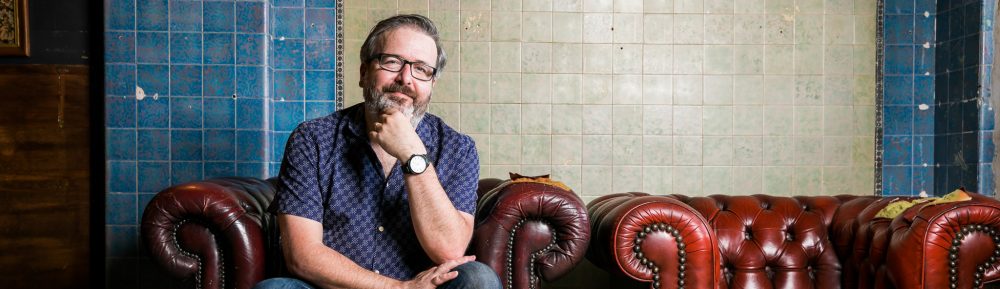

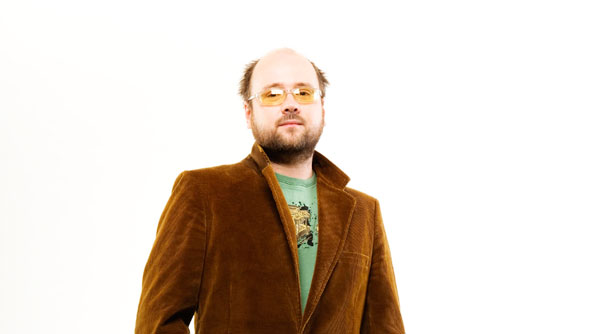
 However, that’s not the only reason he’s coming to our nation. He’s one of the guests of Queensland’s Big Sound music conference, where he’ll be imparting wisdom to the next generation of young musicians and producers. Not that he’s actually thought it through at this point…
 Andrew P Street Is The Internet