Unknown's avatar

About Tyrannicon

Made of fire and caffeine from the very depths of nature's space - of the future.

Graham Long (Wayside Chapel) interview

First published in Time Out Sydney June 2014

Pastor Graham Long takes Andrew P Street through five decades of unconditional love

An extraordinary man.

An extraordinary man.

In 1964, Ted Noffs established the Wayside Chapel in a downtrodden area of Kings Cross. What started as a few chairs in a back room of a crumbling building has grown into the city’s foremost organisation providing frontline assistance and support for the city’s most marginalised people.

For the last decade the Wayside has been under the leadership of paster Graham Long, whose enthusiasm and good humour does nothing to hide his passionate advocacy for social justice, even as he’s dealing with the frantic preparations for Celebration Sunday.

“Actually, yeah, ‘frantic’ is not a bad word,” he laughs. “You go into these things thinking ‘this is a big occasion, we should do something’ and everybody’s got a great idea – until you get close and you think ‘god, who thought of all of this?’ But it will be absolutely enjoyable – when it’s over.”

He’s very clear on why it’s happening though. It’s because Wayside means a lot to people in Sydney – in the most direct, personal ways.

“For the ten years I’ve been here, I wouldn’t have gone anywhere – a party, a wedding, anywhere – where someone hasn’t come up to me and said ‘I was married at the Wayside’ or ‘my kid was buried at the Wayside’ or something like that. Ted Noffs did 18,000 weddings, although that was the days before civil celebrants, so if you were a Catholic and wanted to marry a Protestant Ted was the only show in town,” he chuckles. “But that’s still thousands and thousands of people touched by the Wayside.”

“And the other day I had Ita Buttrose telling me ‘oh, Ted had me working hard around there’ and Jonathon Coleman was telling me he used to sweep the footpath! So many people have been touched by the Wayside, so it would be a shame to let the 50th come and go. There’s enormous value in just stopping for a minute and being thankful that somebody’s here.”

Even when Wayside started Noffs’ determination to help those at the bottom at the pile has drawn condemnation from all sides: the church told Noffs he was wasting his time when he founded the Wayside, and there was even the possibility of arrests and closures when the Wayside decided to open a safe drug injecting room rather than leave people shooting up in the streets.

“We’ve been on the cutting edge many times,” he shrugs. “And we really suffered over that thing – but what it led to was the injecting centre, and that’s led to an 88 per cent reduction in overdose callouts, and deaths on the street have gone down from around 130 to about 12 a year. You couldn’t criticise it on rational grounds. But there are shock jocks and politicians whose job it is to peddle fear. That used to be the job of the church,” he laughs darkly. “Compassion is out of fashion.”

So Long’s noticed our immigration policies, then?

“Oh, there is nothing about our recent history that makes any sense whatsoever,” he declares. “We call these people detainees – but they’re prisoners! In PNG, they’re calling refugees clients. Clients! It would be laughable, if it wasn’t so sad. When you divide the world up into goodies and baddies, you divide your own soul.”

Language is something that Long is very aware of. Those that visit the Wayside are not clients, patrons, users, customers, or any other euphemism.

“We’ve never found the perfect collective noun,” he says, “but the one we use is ‘visitors’. Because when people visit your home, they’re visitors. They’re people, exactly like you and me.”

That’s what the Wayside offers, more than anything else: unconditional love.

“Most people who walk into Wayside believe they’re alone. And if you can overcome that sense of ‘I’m handling this on my own’, when you realise that there are others with you and you are there with others and for others, people just move towards health. We’ve seen it over and over,” he says. “We’ve seen people come to life, and it’s not because we have any sort of therapy going: what we’re creating is community.”

And once the 50th is passed?

“We’re very conscious that this is the beginning of the next 50 years. We’ve been significantly staffing up, and we’ve been building a lot of stuff very recently: we’ve created a garden up on the roof and homeless people can learn to grow their produce, and there’s bees up there as well so we create our own honey,” he enthuses.

“And we want to go further with that: one day when we’re rich and famous we want to build a greenhouse up there. And I have a bit of a dream that we’ll farm fish up there as well. I reckon it’s doable!”

He laughs heartily. “All we lack is a little bit of money, and if you say that quick enough it doesn’t seem like such a barrier!”

The relative value of band members, featuring Queen

First published at Time Out Sydney, 30 May 2014. Art by Robert Polmear.

Andrew P Street explains that band members are not equal. Not even a bit

queen-tour-2014

A certain amount of Queen is coming to Australia later this year, and people are excited about it for reasons that I can’t entirely fathom. Then again, Queen fandom was always slightly out of my reach: I was just a bit too young to love them at the time, and just a bit too old to relive them through a dad’s car best-of, so I was right in their contemporary-with-their-late-period terrible-era sweet spot.

However, let’s be honest: the corpse of Freddie Mercury is more Queen than the rest of Queen – even if bassist John Deacon came back. And the reason for this is simple: regardless of what they say in interviews, no band is a partnership of equals.

In fact, the ranked importance of each member of almost any band in history can be illustrated thusly:

1. Singer
2. Lead guitarist
3. Rhythm guitarist
4. Drummer
5. Bassist
6. Keyboard player/saxophonist/percussionist/whatever

And here is that ranking as a pie chart, because I am very smart and talented:

(“Ringo” is the base unit of musical necessity. Ten Ringos is called a DecaRingo, or one Lennon.)

Note that the lead singer is only slightly less replaceable than all of the members combined. Note also that this is an approximation and does not apply to INXS.

This ranking, incidentally, applies only to bands that play instruments. The rules for boy bands are different: that ranking typically goes Androgynous Hottie, Masculine Hottie, Member With Most Mixed Ethnicity, One You Just Know Will Get Fat, The One Who Writes The Songs.

But back to rock bands: the lead singer is the thing that makes you connect with a band. Instruments are standardised: E major played on a Les Paul through a Marshall stack sounds much the same whether it’s Pete Townshend or your cousin Rebecca. Also, Beccy will take better care of the equipment involved.

However, voices are unique. That’s why bands who replace their singers almost always fail.

Sure, you get the odd AC/DC or Van Halen who keep on having hits, but be honest with yourself: has anyone ever sincerely expressed the sentiment “you know, they really hit their stride with Brian Johnson: Bon Scott was totally holding Acca Dacca back(a)”?

Let me answer that rhetorical-sounding question for you: No. No, they have not.

So let’s go through this one by one.

1. Singer
This is the only person in the band that 90% of fans can identify by name. They stand at the front in photos and have first pick of anyone who wishes to have sex with the band. They might write the songs, but it doesn’t matter, since that voice is the reason why anyone gives a shit. May reform the band after a split and be the only original member, because who honestly cares?
Examples: John Lennon, Paul McCartney, Freddie Mercury, Bono, Chris Martin, Lou Reed, Mick Jagger, Courtney Love, Damon Albarn, Bryan Ferry, Morrissey, Karen O, Tim Rogers, Billy Corgan, Simon Le Bon, Bernard Fanning, Siouxsie, Michael Stipe, Thom Yorke, Grace Slick, Doc Neeson, Alex Turner, Eddie Vedder, Michael Hutchence…

2. Lead Guitarist
Second pick of the sex, gets near the front in photos, and is the member most likely to be referred to as “the architect of the band”. Statistically, this is the member most likely to either write the songs or co-write with the singer. Is legally obliged to have a largely-ignored solo career and/or do soundtracks.
Examples: Johnny Marr, Jonny Greenwood, Keith Richards, The Edge, Noel Gallagher, Eddie Van Halen, George Harrison, Pete Townshend, Pete Buck, Jimmy Page, Angus Young, Slash, Graham Coxon… all the people you know that are in bands but aren’t singers.

3. Rhythm Guitarist
If there are two guitarists, this is the one that stands slightly toward the back and mainly plays chords. If this member is not the main songwriter, they will be fired during the making of the second album and replaced on tour by a hired guitar/keys person. If you’re the second guitarist, you’d better have formed the band, written the biggest hit, or have some amazing dirt on the rest of the band and the steely fearlessness to use it when the time comes.
Examples: Malcolm Young. That’s literally it.

4. Drummer
The member most likely to be called “the heart of the band”. Also the member most likely to keep using drugs when everyone else has cleaned up, have the largest amount of visible tatts, and keep wearing a baseball cap well into middle age. Gets third pick of the sex; second if the band are in their heroin phase. Also is almost always the first member to die.
Examples: Chad Smith, Tommy Lee, Ringo Starr, Keith Moon, John Bonham

5. Bassist
Most likely the housemate of the lead singer, or the friend who bought a van. Still there because they came up with the group’s name. The member most likely to be referred to as “who?” All bassists wake from dreams in which they are Flea, and are momentarily filled with hope and joy. Then they remember they’re actually in Weezer or Coldplay or Jane’s Addiction and that if they died on stage their tech would slot in after four bars and not a soul in the room would notice. In band photos, theirs is the face least in focus.
Note: if the bassist is female in an otherwise male band, she is immediately promoted to #2.
Examples: Kim Deal, Kim Gordon, Stephanie Ashworth, Tina Weymouth, some dudes.

6. Any other player whatsoever
The Fauves gave the world’s most eloquent statement on the importance of other players in their definitive rock’n’roll thesis, 1995’s ‘Everybody’s Getting A 3 Piece Together’: “Everyone’s trimming the fat,” Andy Cox powerfully opined. “Keyboards, percussion? Fuck that.”
Examples: none.

7. The audience
Bands sometimes say their audience are a member of the group. Those bands are patronising you. You are not a member of the group, otherwise you’d have got in for free. On the plus side: you will still get more sex than the bassist.

It’ll probably be with the drummer, though.

The seven best corporate mascots for the Australian government

First published in Time Out Sydney 22 May 2014. Art by Robert Polmear

So very responsible!

So very responsible!

Dear the Internet,

You know what changes hearts and minds? Mascots!

That’s why McDonalds have launched their new mascot Happy – a gaping red box, playing on the universal desire of children to be helplessly engulfed by a sentient cube.

Meanwhile the mining industry have come up with their own character – Hector the Healthy Lump of Coal, who was invented by the company that owns Dalrymple Bay Coal Terminal, looks like a giant, terrifying turd in a safety vest, and has a website that teaches kids all about how to enjoy non-renewable energy.

And in that same spirit of taking something which is objectively harmful and transforming it into something which children will bond with, spend money upon and eventually die as a result of, the government are preparing to launch a range of new fun-loving mascots to help get some popular support for some of their more hard-to-swallow legislation.

Hey, Australia – forget those budget blues and say hello to your new, Coalition-approved BFFs!

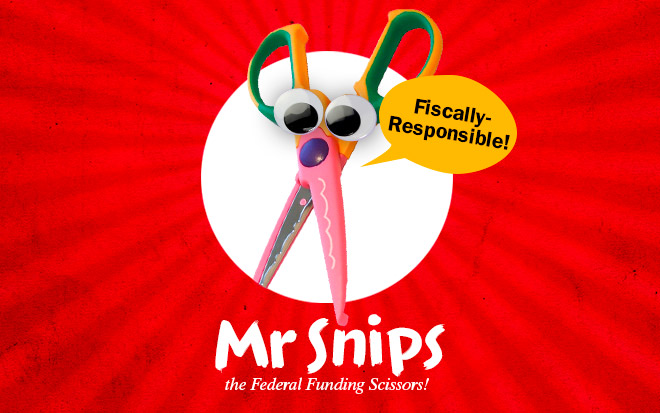
Mr Snips, the Federal Funding Scissors
Snippy-snip-snip! That’s the sound of fiscally-responsible Mr Snips, the fun-loving budget scissors as he goes after his two biggest foes: red tape and programmes implemented by the previous government.

He hates inefficiency, duplication of services, oversight committees, non-industrial advisory groups, and anything not mining-related. And with your help, that deficit will be down to zero imaginary dollars in no time! Snippy-snip-snip!

Ol’ Silty, the Barrier Reef Mining Runoff
All Ol’ Silty wants to do is give out big, warm hugs: to you, to your friends, to the coral reefs inside the Great Barrier Reef Marine Park – everyone!

Ol’ Silty is happy to explain that he helps increase the dangerously-low level of particulate matter currently covering in the current ecosystem and how YOU can help keep this unique environment safe for future generations of supertankers and coal transport vessels.
That cough you’ve developed? It’s like a hug for the inside!

Captain Privilege!
Dressed in his trademark cape and fedora and with Shannon Noll’s version of ‘What About Me’ playing on a constant loop through his belly speaker, Captain Privilege! is ready to leap in and ask why white, straight males are being excluded from the conversation, regardless of what the conversation is about.

Feminism? But what about the Captain? Immigration? But what about the Captain? Marriage equality? Indigenous health and poverty? The National Disability Insurance Scheme? Violence against women? Why are you even having these conversations, since they’re not about the Captain? The Captain is bored now! Let’s talk about the Captain!

Slowpoke Moe, the NBN Tortoise
Lovable old Moe is here to explain why Labor’s vision of a national fibre-to-the-premises network is foolish and wrong. Anyway, no-one even uses computers except for secretaries and personal assistants, and why use the internet when you have Foxtel? That’s the tech of the future, right there.

His presentations are scheduled for 30 minutes. They never come anywhere near that length though, despite lengthy pauses and frequent restarts.

The Welfare-Scrounging Palz: Bludgey, Slutsy and Rollaround Sue
One can’t find a job, one can’t keep her legs shut, and the other can’t even be bothered walking!

The Palz just love to carp and moan: Bludgey would go to the doctor, but can’t afford the GP co-payment since he’s probably blown it all on ciggies and middies of beer, while Slutsy is asking where her kids will sleep if she’s evicted. Oh Slutsy: you couldn’t keep a husband, and now you can’t even keep a lease!

Rollaround Sue is ready to jump her wheelchair through hoops to demonstrate she “genuinely” needs her pension – but first she needs to get it up these stairs, of course. Don’t try the accessible toilet either, Sue: Captain Privilege! is using it for storage.

Toot Toot the Border Protection Tugboat
“It’s a sailor’s life for me!” says Toot Toot. He loves the salt in the air, the waves against his hull, and the plausible deniability of accusations of torture at sea as he scoots merrily back and forth across the Indonesian maritime border, keeping Australia safe from wicked asylum seekers who are deviously planning to [INSERT JUSTIFICATION HERE]

Invite Toot Toot to your school, where he’ll hand out delicious Operation Sovereign Burgers to all students who can provide documented proof they were born in Australia. Where will he visit next? That’s an operational secret!

Whitey the Freedom Of Speech Bigot
Well, technically that’s just attorney general George Brandis.

Yours ever,

APS

All of the writing, all of the time

ImageHey, internet. It’s been a while.

I’ve been doing all of the writing lately, hence the long silence on here. But if you’ve been following at TheVine or Time Out then you’d know I’m not as lazy as this appears. Honest. 

For example: only last night I wrote A Thing About The Voice, because I am A Serious Journalist. Want more proof? Here’s this thing about Star Wars. And why everyone should get over the music of the 90s

And there was lots of music and politics writing – the former for Fasterlouder, Australian Guitar, the NME (seriously: the NM freakin’ E) and the Guardian, the latter for TheVine, and both for Time Out. And Navy Outlook, oddly enough, which is really interesting. And a couple of things for Daily Life, like a piece about Nuts Magazine closing and about things wrong with doing air-sex to random women

Like what? Interviews with Something For Kate, Anna Calvi, a live review of Arctic Monkeys, and a load of… you know what? There’s just a lot of stuff.

And I’m working on some longer form things for reasons that are very good. But we’ll talk about those things later.

Honest. I will. 

Honest.

Yours,

APS


Play the 2014 Federal Budget home game!

First published in Time Out Sydney 15 May, 2014. Art by Robert Polmear

Dear the Internet,

You’ve probably watched with excitement as the all-dancin’, all-smokin’ treasurer handed down his budget earlier this week and thought “heck, I like the sounds of this massively inequitable and unsubstantiated cut-fest!”

Well, we have some great news: you can bring down your own unnecessary and nationally-damaging budget in the comfort of your own home, simply by playing the Department of Treasury’s exciting new spin-off product: the 45% interactive Diamond Joe Hockey Federal Budget and Class War 2014 game!

aps-hockeyboardUsing the same cardboard and string technology that’s now being rolled out to replace the National Broadband Network, you can recreate all the manufactured panic and pious condescension of your federal government in the comfort of your own home! The rules are below, so don’t wait for the Senate to ratify it: start playing today!

RULES

1. The aim of the game is to fix the nation by owning as much of it as possible.

2. Every player starts with $200. That sounds socialist, actually. Scrap that.

3. With the richest person choosing first, every player selects their piece: Mining Magnate, Media Mogul, University Professor, Nurse, Manufacturing Worker, Single Mother, Unemployed Person, and Pensioner. On the box it will say there should be a Disabled Pensioner figure in there, but that’s now been deliberately left out.

4. Mining Magnate and Media Mogul take $5000 each. Everyone else gets $40, except for the pensioner who should have acquired their money before the game began, and the Unemployed Person who has to wait six rounds before getting whatever the Mining Magnate determines is fair ($5 maximum). Single Mother also has to pay a $5 “wanton harlot” levy (not a tax).

5. Everyone gets their wage each time they pass Go (although this requires a $7 co-pay).

6. At the beginning of the game every piece has the choice of paying a $100 upfront education levy (not a tax), or paying 15% of their salary every round. Similarly, there’s a first round $200 “private health cover” payment, or a 30% health levy (not a tax) per round for any player that chooses not to pay.

7. By landing on a property the player has the chance to buy it, although the Mining Magnate can block any purchase by playing her unlimited supply of “fracking” cards.

8. Any purchase must be negotiated with the Bank, except for Mining Magnate or Media Mogul, who can take unsecured no-interest, no-repayment loans from the Bank at any point.

9. Landing on a Utility requires the payment of a $5 fee, unless the utility has been privatised in which case it’s $20, plus a $20 late fee.

10. Every 12th round requires all pieces to pay a flat 30% Contribution Levy (not a tax) for being part of the game. Except for the Mining Magnate and Media Mogul pieces, which for tax purposes are based in Connect Four.

11. The winner is the first person to own the country and become King Patriot. Unless it’s not Mining Magnate, in which case the result will be challenged and Mining Magnate will be declared King Patriot.

RRP: $12 billion (plus $12 billion in operating costs). However, you’ve already paid for it via your forthcoming temporary board game levy.

NOTE: It’s not a tax.

Yours ever,

APS

Your post-budget ABC TV programme guide

Published in Time Out 8 May 2014, art by Robert Polmear

Dear the Internet,

Next week your treasurer Joe Hockey will hand down the Abbott government’s first federal budget, and you can feel the excitement in the air. Will universal health care be destroyed, or merely demolished? Will higher education become the exclusive purview of the super-rich, or will the common-or-garden wealthy still get a look-in? And how generous will the tax concessions to the mining industry be – will they have to make do with free money, or will we finally introduce blood tributes from every Australian family?

aps-abcuts

One thing that’s certain is that the ABC will be seeing some serious cutbacks, despite that whole no-cuts-to-the-ABC-or-SBS thing that your PM said before the election. To be fair, what he said was deeply ambiguous and opaque:

…so you can see why he’d be annoyed at the way his promise has been misrepresented as being some sort of promise.

In any case, there’s no need to fret about having your national broadcasters taken out behind the bike sheds and given a going over with a tyre iron. We’ve managed to get hold of the ABC board’s top secret post-budget programme line up, and are delighted to see that the broadcasting quality will be deeply efficient.

Enjoy their new Abbott-mandated “commitment to axcellence”!

Social Media Watch
With no budget for newspaper subscriptions, Paul Barry criticises the spelling in his Twitter feed until his phone runs out of battery.

3.6 Corners
The flagship current affairs program gets a 10% cut, and is now filmed in Kerry O’Brien’s garage. The exposé on the appalling storage of old paint cans and Xmas decorations is already tipped to sweep the Walkleys.

Work School
With higher education off the table and pensions only open to those who crack the big seven-zero, it’s important to get children past walking age (of entitlement!) nice and early. Hamble and Big Ted now have casual telemarketing jobs, while Little Ted is a freelance copywriter-slash-barista and Jemima appears on the show for the week per month she’s not rostered on at the Roy Hill iron mine.

Whatever the BBC leave out by the bins
A cavalcade of classic entertainment, lovingly curated by the former housemate of the head of drama, who works near Broadcasting House in London and is happy to check the dumpsters on her way to the bus stop. Just how many series’ of Keeping Up Appearances did they make? Find out after May 13!

Rake
With Richard Roxburgh far too expensive, the fifth season now follows the sexy adventures of an actual Bunnings leaf and grass rake. Also filmed in Kerry O’Brien’s garage.

The Test Pattern
This classic ABC favourite makes a long-overdue return to our screens from 7pm to 10am every day of the week. Follow the zany, entirely static adventures on ABC 1, 2, Kids, iView or the new interactive test pattern postcard.

Spicks
The specks were just too expensive.

Yours ever,

APS

So, Australia, when did racism become OK again?

Originally published at Time Out Sydney 3 April 2014. Art by Robert Polmear

Dear the Internet,

So: when did we all get so cool with being racist?

Gotta say, our national hatred of brown people really sneaked up on me, not least because I’m a white middle-class straight man and therefore demographically the least likely sort of person to encounter open bigotry while at the same time being the most likely sort of person to angrily demand my right to dispense it.

aps-racistNow, you might think I’m overreacting, but you know what? No, I’m not.

The biggest message that our government – and, let’s be clear, federal opposition – has put forward is that we need to Stop the Boats. And we all know why that is.

It’s certainly not because of the cost of dealing with asylum seekers, since it was orders of magnitude cheaper to house people in Australia, process their application and then either deport them or release them into the community, as opposed to the millions it’s costing us every month to use our Navy to drag ships back out to sea while we imprison people indefinitely on isolated islands where all food, water and fuel needs to be expensively shipped in.

It’s not because they’re a danger to us or our way of life: people who’ve given all their money to people smugglers in a last-ditch effort to escape their country aren’t exactly brimming with resources and options.

Sure, some folks argue that there are people who deserve to be here and people who do not. And I can’t help noticing that those who apparently do not deserve to be here coincidentally tend to have complexions rather duskier than those of our federal front bench.

And we know it’s not a matter of gosh-darn principle about people playing by the rules. After all, we don’t incarcerate Irish overstayers. We don’t send US students with expired student visas to Manus Island. We don’t jail English folks who’ve decided to do sneaky bar work while ostensibly here on a holiday visa.

So let me spell it out in nice, unambiguous terms: the people that want our help the most are varying shades of brown, and Australians just don’t like brown people.

We sure as hell don’t like the brown people who were here when the First Fleet arrived, since then we’d have done something about the fact that they live, on average, a decade less than non-indigenous folks – and even less if they live in remote communities (between 12 and 14 years less, specifically).

And let’s reflect on our recent history.

In February a young brown man named Reza Barati was murdered during a detention-centre riot on Manus Island. And our government are not at all keen to investigate this murder properly, hence shrugging at the deportation of the chief investigator and the refusal of the Australian Federal Police to help local police in PNG, despite a direct official request. That came after a human rights inquiry into the centre was shut down, incidentally.

 Then less than a month after the abovementioned prisoner had his skull bashed in with a piece of wood, our snowy white attorney general George Brandis announced that our anti-discrimination laws are too repressive and needed reform because “people have the right to be bigots, you know”, and he was concerned that bigots weren’t being adequately protected. Oh, Australia, will no one think of the bigots?

Then our immigration minister Scott Morrison suddenly removed all legal aid for asylum seekers this week, which seems fair only if it turns out that everyone who desperately flees here with nothing more than the shirt on their back is fluent in English and also an experienced lawyer with particular expertise the constantly changing legislation regarding Australia’s immigration policies.

The fact that he did so immediately before getting rid of a group of detainees taking legal action against the Department of Immigration for making their private details public shows what an odious trick it was: aid was cut on Monday, the detainees are being relocated to remote WA on Thursday, and the case comes before the Federal Court in Sydney on Friday.

In all of these cases, the people insisting that people had had it too good for too long were of one race, and the people they were putting at disadvantage were coincidentally not that race.

And I don’t think we realised how bad it was getting. And it’s not just me who’s noticed. There’s no shortage of overseas editorials about Australia’s virulent bigotry at the moment.

And just to be clear, racism’s not OK. Like, not even a bit OK. And you know that.

Now, there’s a good chance you’re thinking “b-b-but I’m not a racist! I didn’t close this browser window the second I saw ‘asylum seeker’. I’m a good person!”

And you’re probably right. So prove it. Right now.

Click on this link and donate whatever you can afford right now to the Asylum Seeker Resource Centre, who – among other things – provide legal aid to the people who now have no other option.

Show that you aren’t scared of helping people. Get a glorious thrill of righteousness knowing that you’ve made a practical difference, however small. Even a tiny pebble can be the thing that triggers the avalanche, right?

And yes, it’s something small. We can do more, and we will do more.

But right now, today, we can do this.

Yours ever,

APS

February 28, another long overdue update

Oh, dear internet,

I’m sorry. I’ve been neglectful. It’s been a while. Too long, really.

The Arrested Development trivia thing went really well, thanks, I reviewed a tonne of stuff for Sydney Festival, reviewed a bunch of films for the Sunday Telegraph, and did other stuff, probably. To be honest, January was kind of a blur.

Everything will so much easier once I have this going on.

Everything will so much easier once I have this going on.

February too, actually. Why? Funny you should ask.

Writing, mainly.

The regular 10 Things stuff’s been turning up at the Vine every Mon-Thurs morning at some ungodly hour – most recent bunch are below – and I was off in Adelaide doing some travel story research and then in Perth covering Perth Festival for the Guardian, which was great fun – saw one great show, one good show and one kinda lousy one, did interviews with Kate Stelmanis from Austra, Will Sheff from Okkervil River, Colin and Graham from Wire and Flavour Flav from Public Enemy, and knocked out a Perth Music in 10 Songs thing which left out a load of amazing music.

For the Guardian I also interviewed Neil Finn, and wrote about the awesomeness of the Paul Kelly/Kev Carmody classic ‘From Little Things Big Things Grow’.

Actually, all my Guardian stuff is easily found right here, should you fancy reading it. 

Also, iI did a load of stuff for Time Out, most of which is in the current issue which is on newstands right now (including a bar review of the revamped Argyle Hotel in the Rocks, which has a great dumpling bar these days: an idea I would like all things to now incorporate, including but not limited to bars). One thing was a very fun Iron & Wine interview.

And I did my snarky Word on the P Street weekly columns for Time Out, which featured my worst song of all time countdown: the publicly voted Nottest 100 (and the results are here).  Also which played-out Australian dining trend are youyour Australian government rating-busting television events of 2014Sydney or Melbourne: which city will kill you first?, and… actually, let’s make this easy: all the Word on the P Street columns are here. Go read the hell out of ’em.

Elsewhere, I bitched about the INXS telemovie for Fasterlouder, and also did a thing on the Morning Show about INXS videos. So you can see and hear me LIKE I’M RIGHT THERE. Yes, you’re right: I’m much better looking in print.

I also did a thing on being friends with someone you find attractive for Daily Life, because I move in incredibly good-lookin’ circles.

And I did some radio for the ABC, and a lot of print writing which hasn’t come out yet – but it will, I’m reliably assured.

And here’s the most recent 10 Things below, if you want to feel angry and ashamed about being Australian at the moment. You’re welcome!

You going to Golden Plains? I’ll see you there, then.

Yours ever,

APS

10 Things - So, who beat Reza Berati to death? 10 Things – So, who beat Reza Berati to death?

10 Things: Environment minister sick of dumb 'environment' stuff 10 Things: Environment minister sick of dumb ‘environment’ stuff

10 Things - Fred Nile expresses disapproval of choices made by dead woman 10 Things – Fred Nile expresses disapproval of choices made by dead woman

10 Things - Holiday in Cambodia! 10 Things – Holiday in Cambodia!

10 Things - Schapelle 2: Electric Boogaloo begins production 10 Things – Schapelle 2: Electric Boogaloo begins production

10 Things - Why you should be ashamed to be Australian right now 10 Things – Why you should be ashamed to be Australian right now

10 Things - Today in Chris Brown hits people news 10 Things – Today in Chris Brown hits people news

10 Things - Patience is a virtue 10 Things – Patience is a virtue

Sydney or Melbourne: which city will kill you first?

First published in Time Out Sydney 27 February 2014

Dear the Internet,

The Guardian recently published an interactive map showing how one’s life expectancy changes depending on where in the world one lives. It’s a fascinating tool unambiguously showing that people in big cities tend to live significantly longer than those in rural and remote deathtraps.

Come for the stress, stay for the not being a hellhole in the middle of a bone-dry mountain range!

Come for the stress, stay for the not being a hellhole in the middle of a bone-dry mountain range!

However, looking at our wide brown land that’s girt so controversially by sea, it’s notable that those who live in Sydney apparently die six weeks earlier than the national average.

It’s hardly a surprise, of course: life in our biggest and most exciting/stressful city is a rollercoaster of pluses and minuses. To illustrate this, I’ve elucidated the elements that extend and diminish life for Sydney residents, alongside those of our nation’s secondary Sydney: Melbourne.

Sydney vs Melbourne 2

So which city is better? One thing is clear: they both shit all over Blinman.

Seriously. You ever been to the Flinders Ranges? The town’s a goddamn hellhole.

Yours ever,

APS

Kris Kristofferson interview

First published in Time Out, February 2014

The country and cinema legend looks back at his legacy

Let’s not mince words: Kris Kristofferson is an honest-to-god legend. The man is one of the great American country songwriters – ‘Sunday Mornin’ Coming Down’, ‘Me and Bobby McGee’, ‘For the Good Times’ – and was one quarter of the outlaw country supergroup the Highwaymen, standing tall alongside Johnny Cash, Waylon Jennings and Willie Nelson.

He’s also an accomplished actor, probably best known for starring roles in A Star Is Born and Alice Doesn’t Live Here Anymore. He also has the peculiar honour of having starred in one of the most disastrous films of all time, the studio-killing 1980 Michael Cimino film Heaven’s Gate.

kris-kristoffersonIn 2013 he released his 21st album, Feeling Mortal: a typically wry album reflecting on his 77th year on the planet, and he’s coming to Australia for over twenty shows all over the country, including such non-traditional touring destinations as Rockhampton, Lismore and Renmark.

“I’m looking forward to the tour,” he chuckles in that immediately-familiar rasp. “I’ve been doing a film up here and I’m tired of it. I feel pretty lucky to make my living like this, but I really like the music part better than the movies.”

Most performers half Kristofferson’s age don’t do Autralian tour schedules this long, much less this extensive. “Well, I’m glad to be doing it!” he laughs. “I’ve always enjoyed playing in Australia: I’ve always felt a good connection with the audience for some reason.”

Feeling Mortal follows 2009’s equally strong Close to the Bone, and the recurring motifs of loss, mortality and experience make them seem almost of a piece.

“Well, ever since the first albums that I cut, I feel like it’s represented what I was going through at the time, and I think that’s why. I mean, I certainly feel mortal – if you don’t feel mortal when you’re 77, there’s something wrong.”

That being the case, what sort of person makes an entire album about feeling one’ s age, and then goes “…and so now for an extensive world tour where I perform night after night after night?”

“Yeah, but there are a lot worse ways to have to make a living, you know? It’s definitely the thing that comes the most natural to me.”

The sets naturally include his old classics, and Kristofferson feels absoutely fine about performing songs he wrote forty-odd years ago.

“I guess it’s kinda like your kids: once it’s yours, it’s yours,” he shrugs. “Songs like ‘…Bobby MaGee’ and ‘Help Me Make It Through the Night’ will always feel like my own.”

Sure, but every parent still has moments of feeling like “I love you, but I really don’t want to hang out with you right now”?

“No!” he laughs heartily. “But I tell you, my kids and I get along real good. I got eight of them and they are really easy to be around. When they’re together all I hear it laughter. It’s a blessing. And they’re all smarter than I am.”

That’s no small claim: Kristofferson was a Rhodes Scholar, before rising rapidly through the military as a pilot before music and acting caught his attention. The man has a brain on him.

“Yeah? Well, that’s kinda hard for me to believe too,” he laughs. “But I got no complaints.”

He’s pleased at the suggestion that Feeling Mortal is less a dark reflection on the proximity of the reaper and more of a wry celebration of a life well lived.

“I’m glad you feel that way, because that’s the way I feel. I really don’t think anything negative about gettin’ old. It happens to everybody,” he says, “and I’d rather get old than not.”

Which is a rare sort of attitude for someone in youth-obsessed industries like music and movies, but Kristofferson doesn’t sound like a man that gives much time to doubts.

“You know, I was never worried about whether I was like the other people or not. I’ve never felt any pressure to be as good as Johnny Cash, or Waylon or Willie – I used to just stand up there amazed to be on stage with them. And I feel that way about the films as well, and I have no idea why I didn’t have more doubt about whether I could do it. But it’s all worked out.”

Well, it appears that if it didn’t work out, there;d have been no hesitation in trying something else.

“Yeah, it’s true. Looking back, I was into football and boxing when I was at school, and that was what I could really lose myself in. And I don’t know how I could have been audacious enough to do either one: I wasn’t big and I wasn’t fast, but I still got to play and I think it was just – like the music – that my heart was in it. It’s like songwriting: I’m sure many people in the world thought I was crazy to go from being an army officer to being a studio janitor trying to be a songwriter, but I never questioned myself – and I’m glad I didn’t.”

Not even when making Heaven’s Gate?

“Well, I always thought it was a good film, but it didn’t last a week in the theatres. The critics gave it unfair reviews,” he shrugs. But look back at it now: great actors, great director. What an opportunity!”